
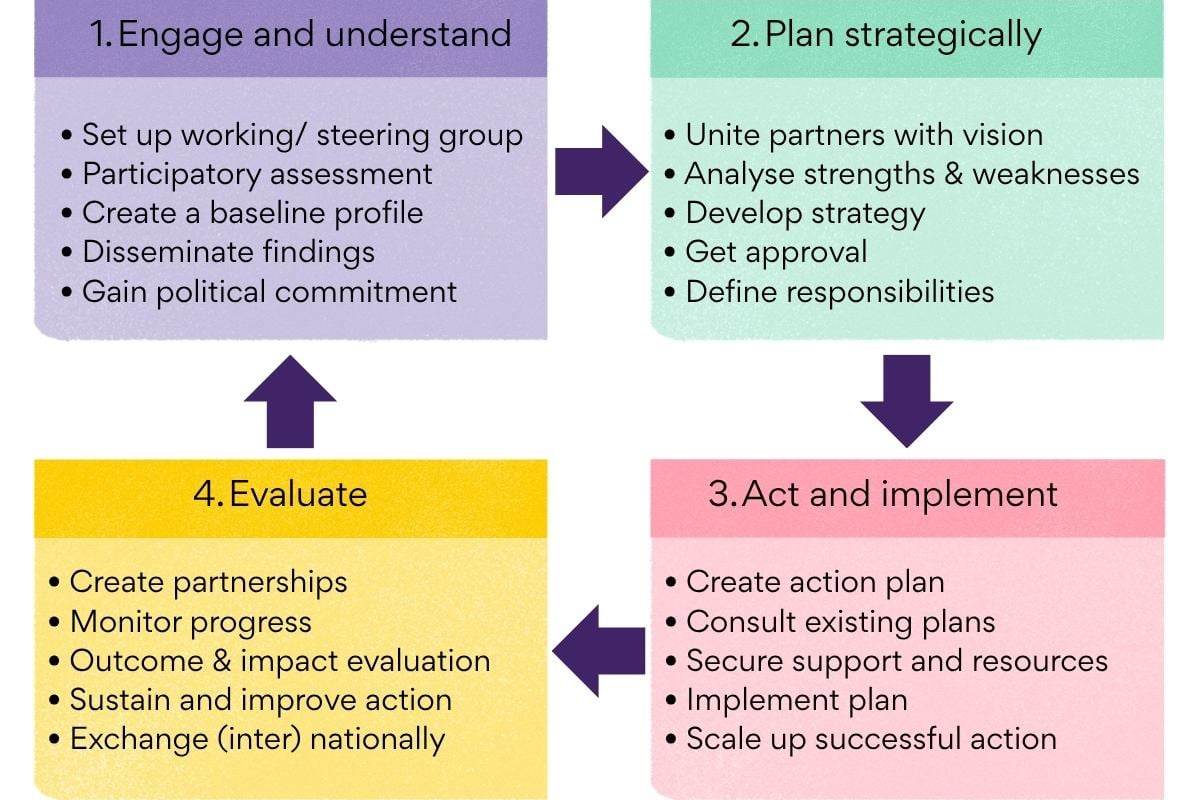
The WHO’s Programme Cycle typically takes about five years, but becoming a more age-friendly community is a journey, and communities go at their own pace depending on resources.
The first step is to engage local leaders, stakeholders and older people and work to understand how ‘age-friendly’ your community currently is, so your activity can respond to current needs and opportunities. This step will include gaining political commitment, establishing a steering group, deciding who will coordinate the work and beginning a baseline assessment.
Next, communities will use all the information gathered in the first step to determine their local priorities for action. This step will involve communities establishing a shared vision, identifying priorities based on local needs and writing an age-friendly strategy.
In the third step, Age-friendly Communities will create and deliver on an action plan that achieves their strategic priorities with whatever resource they have. Some communities will combine their strategy and action plan. The action plan will sit across the community with different partners taking responsibility for different actions.
Whilst communities will monitor their progress throughout, in the final step Age-friendly Communities will evaluate their progress in implementing the framework and difference their work has made on local peoples’ lives. They will use this learning to begin the cycle again.
Further guidance on how to develop the first step of the Programme Cycle can be found in our getting started delivering your age-friendly community guide. Support to deliver across the four stages can be accessed by UK Network members outlined in our Members’ Pack.
Creating Age-friendly Environments in Europe provides an overview of the Four Steps from the World Health Organisation.