Why employment matters for healthy ageing: reflections from General Practice
Dr Ballal Seddique is a Tower Hamlets-based GP who has recently started a new role with the Connect to Work Programme, a government employment support programme for adults facing barriers to employment such as disabilities, long-term health conditions, housing instability, or caring responsibilities.
Having seen how being made redundant has impacted the wellbeing of many of his patients in their 50s and 60s, he believes enabling more older adults to engage in meaningful work could have substantial benefits for their physical and mental health.

As a GP, I am privileged to hear people’s stories at moments of change and vulnerability. A significant number of the patients we see in a day are often coming to us about work - whether itis about work pressure, loss of work, or health issues that make it hard to work. For many people in later working life, employment provides structure, purpose, and social connection. These elements are fundamental to healthy ageing, yet they are often overlooked when we think about health in later life.
When work disappears
A 62-year-old man came to see me visibly distressed. He had just been made redundant after 25 years with the same company. “At my age,” he said, “I have no idea what I’m going to do next. I can’t go back to working on a construction site - I don’t have the back for it anymore.”
This patient’s experience is far from unique. Many older adults find themselves suddenly without work, often after decades of contribution and loyalty. The modern labour market can feel unforgiving. The psychological shock of redundancy in later life is often compounded by ageism, reduced confidence, and a fear that opportunities are simply no longer available.
Fortunately, Tower Hamlets has a Connect to Work programme, centred on supporting residents, particularly those facing health, disability or other barriers, into suitable, sustainable employment through specialist support.
When work sustains health
The health benefits of being in work are clear to me when I think of Maryam.
During one evening clinic, a mother arrived late with her unwell child. She spoke no English, and the advocacy service had officially closed. I called anyway, hoping someone might still be there. Maryam answered. She translated calmly and compassionately, enabling me to treat the child and ensure the mother felt safe over the weekend.
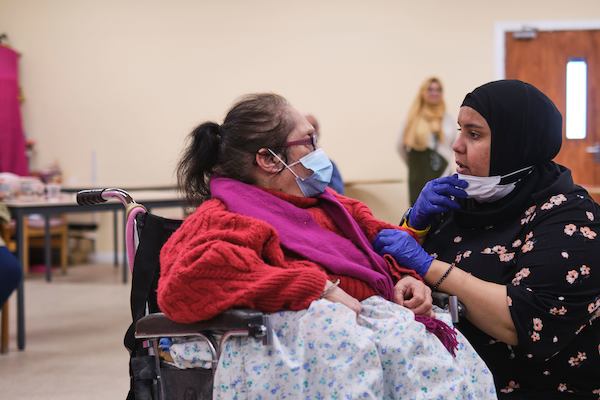
Maryam is 70 years old and has worked in the NHS for 43 years: within midwifery, district nursing, health visiting, and now as a Bengali health advocate in Tower Hamlets. She works compressed hours from Monday to Thursday and keeps Fridays free for prayers. Her weekends are spent with family and grandchildren, which she jokes is harder work than her paid job.
What makes Maryam’s story particularly striking is her own health history. Over the years she has lived with breast cancer, asthma and COPD, strokes and spinal cord compression. At one point she was unable to work for a year. She lost mobility and confidence and needed prolonged rehabilitation. She now walks with walking aids and works from home.
Work, she tells me, is her sanctuary. It gives her routine, purpose and joy. Patient contact keeps her mentally sharp and emotionally connected. Her colleagues and patients adore her.
Maryam’s experience illustrates that work can be profoundly health-promoting, even - and sometimes especially - for disabled people or those living with long-term conditions.
What the evidence tells us
The research supports what many clinicians observe. Unemployment is associated with increased risk of mental health disorders, poorer self-rated health, higher rates of cardiovascular risk factors, and increased all-cause mortality. These effects are shaped by the duration of unemployment, income, education, and the strength of social networks.
Equally important is the protective role of ‘good work’. Employment can support physical activity, cognitive engagement, and social participation. It can also act as a buffer against isolation and loss of identity, which are significant drivers of ill-health in later life. As illustrated by Maryam’s story, flexible working and reasonable adjustments can enable people with health conditions to remain economically active and socially connected.
At the heart of this though is the need for trusted and accessible support. People navigating job loss or health-related work transitions often benefit most from help embedded in familiar settings, such as primary care, community organisations, and local employment services. These trusted spaces are vital in helping people to access training, rehabilitation or alternative roles that reflect their skills and changing capacities.
Towards healthier ageing through better work
Whilst these patients come through the doors of GP practices across the country, it’s not only about medical care. Supporting older adults to remain in, return to or reshape employment, is a public health intervention.
What will help to make this intervention a success is for employers, employment support staff, individuals and society as a whole to challenge negative and false ageist assumptions about older workers’ productivity, investment in lifelong learning, as well as greater flexibility in job roles that allow all workers to balance their work with managing any health conditions or caring responsibilities. It also requires closer collaboration between health services, employers, local authorities, and the voluntary sector.
From my vantage point in General Practice, I see both the harm caused when work is lost without support and the positive impact people have when they are able to keep contributing in ways that work for them. There is no doubt that employment - when it is fair, flexible and meaningful - can be a powerful foundation for healthy ageing.
Maryam’s story is not remarkable because she works at 70, but because her work has been shaped around her life, her faith, and her health. This shouldn’t be exceptional in this day and age, yet sadly it is. If we want more people to age well, we must take the work/life balance just as seriously as we take medicine.
The State of Ageing 2025
Read the Health and wellbeing chapter