Sade’s story: “We’re basically paying to heat the street!” A family’s 15-year struggle to stay warm and well each winter
Sade is a 62-year-old actor who lives in a three-bed council flat in Lewisham with her husband and their daughter.
She has lived in London all her life. Sade has been pursuing her acting career for the last six years, as her children are now grown up and she has more time to do so. When she is not acting, she works as a receptionist.
She met her husband at a party in London 30 years ago and they got married in Nigeria before building their life together in South London.
The family have lived in the flat for the best part of 15 years and have many happy memories there. However, whilst the flat has double glazing, it is poorly insulated with thin walls, meaning that each winter they struggle to keep warm. The living room is the warmest place in the house, with the other rooms being cold and very difficult to heat.
All the other rooms are like being in the Arctic. We are basically just heating the street! All the heat goes through the wall, and we are wasting our money.
In order to keep warm, the family rely on electric heaters and wearing several layers of clothes, though they avoid using the heaters as much as possible due to the costs of running them. Sade believes their heating costs are much higher than the average household because they have to turn the heaters on for several hours before the flat gets warm enough.
This is particularly problematic as her husband has diabetes, meaning his immune system is compromised and he is more susceptible to illness. What’s more, the cold can trigger blood sugar lows, known as hypoglycaemia, in diabetic people.
Sade believes that the intense cold in the house have made hcer husband ill on several occasions. Sade describes her husband as ‘one of those people who doesn’t miss work for anything’, yet the levels of cold in the house mean that her husband struggles with illness and has to miss days of work due to his condition.
Sade’s daughter, like her father, is prone to illness from the cold in the home, regularly developing coughs and colds in the winter and struggling with poor health. The family allow her to use her electric heater more frequently than they can comfortably afford, as they know that she needs to be warm or she will get ill.

It’s just not right for our health. There’s no way you will not get sick in that room.
Sade also feels her own mental health has been negatively affected by the cold, stating that it makes it very difficult for her to do even the most basic of tasks as she is cold ‘all of the time’. She spends much of her time frustrated and concerned about the cold and is constantly monitoring the family’s use of the heating because she is worried about the cost of bills.
They have asked the council for help several times over the years, but no action has been taken to improve the insulation or energy efficiency of the home. The council informed her that it would be her responsibility to pay to have heat-reflective foil fitted behind the radiators.
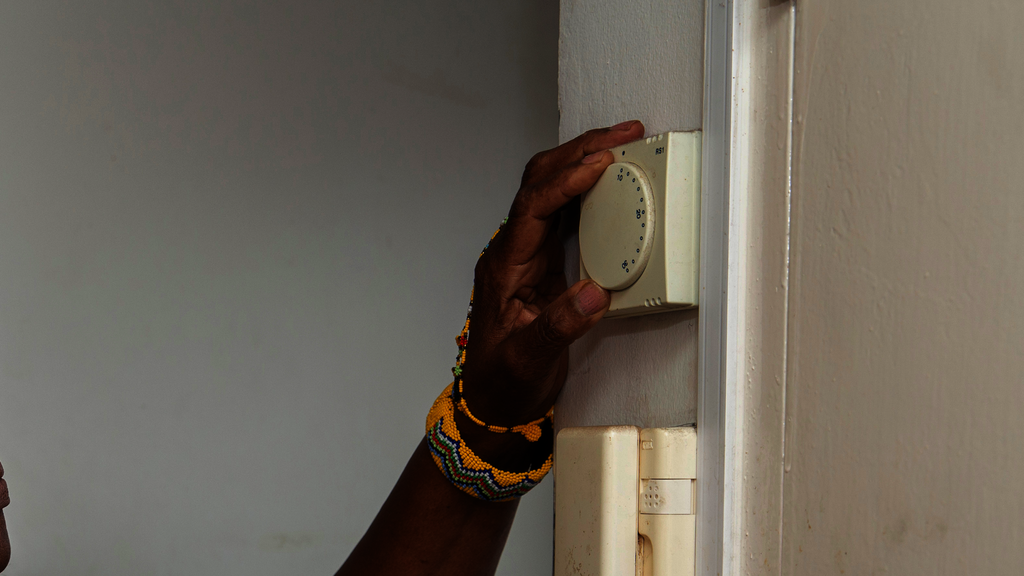
They’ve seen how cold it is with their thermometer. We’ve lived here and complained for so many years, but nothing has been done still. I just want something done and I want them to answer me.
Taking matters into her own hands, Sade opted instead to cut some foil backings to size and place it behind the radiators. She believes this has made a small difference and wishes she had been given support and advice from her local authority on this years ago.
They have had issues with mould in the past which were addressed by the council, but the cold in the house creates a lot of condensation. Sade says her clothes are constantly wet from the condensation and excess moisture in the air.
You would think somebody poured water in my cupboard! I have to iron my clothes each time before I wear them.
Sade’s family’s story highlights the need to invest in our current housing stock and ensure that people can stay warm and dry in their homes over the winter. Four in five homes that will exist by 2050 are already built. If we do not invest in reliable and trustworthy home improvement support, these issues will continue to harm the physical and mental health of multiple occupants in the future too.
We need a Warm Homes Plan that is fit for purpose and for the scale of the problem. A plan that will support millions to effectively insulate their energy inefficient homes that currently leave people to suffer the consequences of cold homes and exorbitant energy costs. There is no time for delay.